
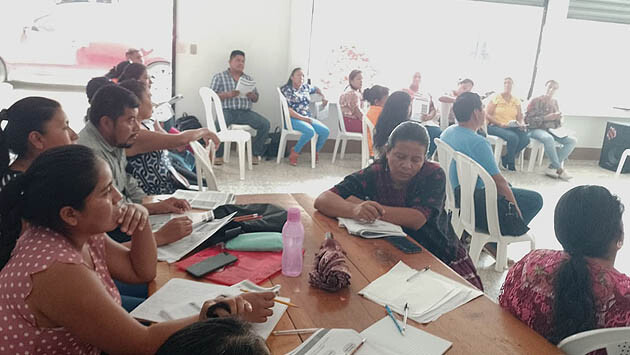
In Petén we are training 60 teachers in sexual education applied to the classroom , with a focus on rights, ethnicity and gender equity. We do it jointly with the country’s Ministry of Education, so that upon completion the students will have a Diploma in Comprehensive Education in Sexuality and Violence Prevention.
In Petén we bring sexual education closer to the classroom. We do this by training 60 teachers addressing the issue with a focus on rights, ethnicity and gender equality and in collaboration with the Ministry of Education, which provides pedagogical advisors. They teach the classes in a playful way and with adequate tools so that each teacher can use them with her students, taking into account the age and language of the children and young people to whom the subject will be taught.
Thus, among other topics it works:
– The importance of education on rights and equality for the prevention of violence
– sexuality as part of the educational process of people, helping to eliminate misinformation and the various forms of violence associated with it
– The recognition, acceptance and appreciation of all people in social and cultural interactions, which allow a harmonious coexistence with the environment.
teen pregnancies
The lack of information on sexual health and rights places children and adolescents in situations of vulnerability to sexually transmitted infections, abuse, or unwanted pregnancies. Schools and their projection in the community allow the promotion of significant learning to reverse the alarming statistics of the increase in pregnancies in adolescents and girls , the increase in people infected with HIV, combat maternal mortality and the exercise of gender violence, as well as discrimination and racism.
From January to April 2023 , 21,290 births to adolescent mothers , between 15 and 19 years old, have been registered in the country ; and 809 of girls under 14 years of age ( Renap data ). A pregnancy at an early age, in addition to hiding possible situations of abuse, truncates the life project of girls and adolescents, when many of them already have a complex future. The average schooling among adolescents between the ages of 15 and 19 is seven years, but if they are indigenous and live in conditions of poverty, they hardly exceed 6 years of study (Mesa in favor of girls and adolescents and the Population Fund of the United Nations).
Comprehensive Education in Sexuality makes it possible to combat the lack of information and taboos in relation to the subject, addressing it from ethical, biological, emotional, social, cultural and gender aspects, based on scientific evidence and in accordance with the development of the person, from their childhood to adulthood.
Recent Comments