
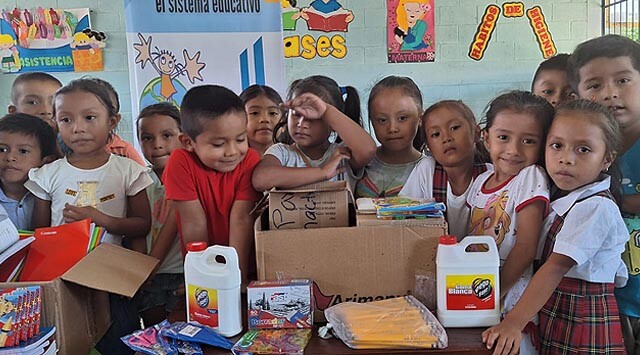
During the months of April, May and June we were acquiring the necessary material to distribute school supplies to 4,461 boys and girls from 60 educational centers , and pedagogical materials to facilitate attendance and guarantee the strengthening of learning in the classroom. And it is that in Guatemala, this 2023 all classes have been resumed in person for the first time since the health pandemic began, in 2020, and in 2022 after the lifting of confinement, schoolchildren have been studying hybrid.
Access to formal education is unequal in Guatemala, with girls and boys from rural and indigenous communities being the most affected. In this context there are factors that come together, such as the lack of resources of families and teachers; the lack of connectivity (many communities lack electricity) and also the language factor is important, since there are no schools that teach classes at certain educational levels in the mother tongue.
Poverty makes many families decide to enroll some of their children and leave others out of the school system, or to rotate them by course. Many indigenous boys and girls start working at an early age, helping at home or in the fields. This makes it difficult for them to go to school and learn, and prevents them from completing their primary education or, in some cases, from even entering the educational system. In the case of girls and adolescents, the opportunities for schooling are even fewer. Hence the importance of working together with communities and teachers to support basic education, from improving classroom resources to awareness sessions for families.
According to a study by Cepal* on the gap in access to education, children enter the education system gradually and late. Initial access is minimal, although at 7 years, almost 100% of children attend school. T he tendency is for children to remain in the system until they are 12 years old, from the age of 13 a large part leaves, practically half.; of those who are, (from pre-primary 4 years and secondary, 18 years) only 39% of them are of the age that corresponds to them.
The drop in net rates is deeper in rural areas, even in primary education. At this level, repetition, and with it overage, become one of the greatest challenges to guarantee permanence in school.
Recent Comments