
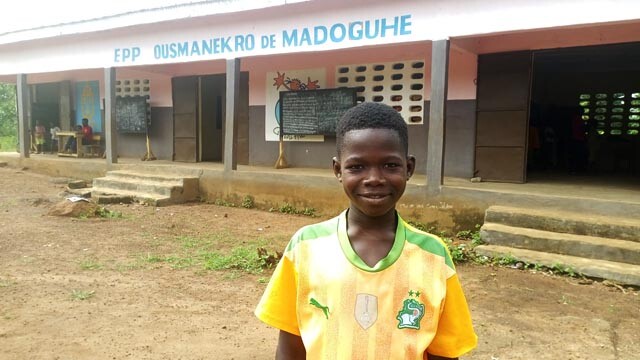
In Ousmanekro de Madoguhe (population 2,030, Ivory Coast), we are expanding the school we built in 2024 with the help of the Gran Canaria Island Council and the support of the local community. At that time, we built three classrooms and six latrines for more than 150 students. Now, we are completing the infrastructure with three more classrooms and a school cafeteria.
Fofana is one of the students at the school. He is 14 years old and is finishing primary school. ” Sometimes ,” he says, ” it’s hard to go to school every day… when it rains and I don’t have anything to eat. What I like most is math. I would like to continue studying to become a nurse and help the people in my village .”
Albert N’guessan, a teacher at the school, explains that ” family income depends mainly on the agricultural seasons, which makes the financial situation of these communities extremely difficult, and children are the most affected .” He adds that “despite everything, parents strive to keep their children in school, but some must help with the farm work .” Thus, as the school’s principal, Artur Ange Kouadio, says, ” having a school in good condition and a cafeteria greatly helps with the education of girls and boys and improves attendance .”
Cocoa and coffee plantations are the most important sources of income in Ousmanekro, an area where malnutrition is widespread. Poverty, lack of access to clean water and basic healthcare, as well as child marriage and labor, form the context in which Global Humanitaria carries out its work building schools and soup kitchens, and supporting schooling in Bodouakro through sponsorship programs.
Recent Comments