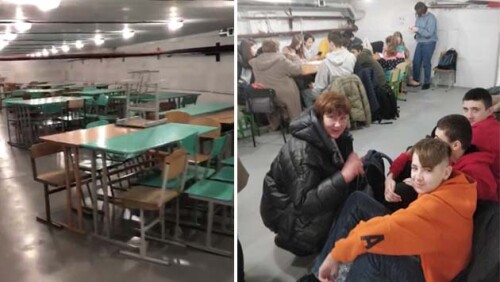
Global Humanitaria, with the aim of defending the right to education of children in conflict, improving access to quality and inclusive education and reducing inequality, has set up a 600m2 shelter for a school in the city of Bila Tserkva (Kyiv region). The project carried out will allow 1,089 students between the ages of 6 and 17 to attend face-to-face classes, in a safe space. And it is that according to regulations of the Ukrainian Ministry of Education and Science, classes can only be taught if the schools have a shelter and approved early warning systems.
This refuge makes it possible for schoolchildren not to get interrupted in their learning and for them to interact with children of all ages and close to 70 teachers. They will be accompanied in their tasks and may also receive support for mental health needs or problems (anxiety, depression, and social disability), produced by the current situation, in addition to having access to a controlled environment.
According to UNICEF data, it is estimated that more than 5.7 million school-age children have been affected since the start of the war, of which 3.6 million are due to the closure of schools. This situation has caused a devastating impact on the well-being of the entire population, also generating concern in the area of education and development. In fact, since the start of the conflict, more than 2,400 educational centers have been attacked according to data from the country’s Ministry of Education.
Since the start of the war, Global Humanitaria has carried out emergency actions in Ukraine with the support of partners, organizations such as the General Council of Spanish Lawyers (thanks to whose collaboration we were able to deliver food in Kherson) and companies such as PCL or EMMA, which has donated material to distribute in centers that have been set up as shelters for the population in Bila Tserkva.
A right above conflicts:
Education is a fundamental right threatened by situations of various kinds, ranging from poverty, gender discrimination to entrenched conflicts and wars. In these contexts, children are vulnerable to child labor, abuse, exploitation, or marriage.
As we have commented, in Ukraine, 11 months after the start of the conflict, millions of boys and girls have had to interrupt their education. The inaccessible facilities or the insecurity that parents send their children to class causes many to stay out of the classroom. In addition, in neighboring countries, it is estimated that 2 out of 3 Ukrainian refugee children are not enrolled in the host education system. ( UNICEF )
Of the most recent, the conflict in Syria has also had serious effects on the education of the country’s children, leaving more than 7,000 schools damaged or destroyed and close to 2 million children without schooling.
Likewise, coinciding with World Education Day, UNICEF has put on the table that there are more and more boys and girls who have never been enrolled in a school and urges prioritizing education to accelerate progress towards all the Education Goals. Sustainable Development in a context of global recession, growing inequalities and climate crisis.
Recent Comments