
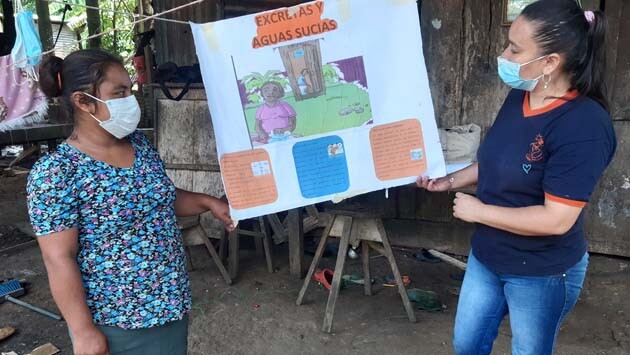
During the month of October, we’ve made daily domiciliary visits to 26 families from three mayan q’eqchi communities that participate in the program of Healthy Homes.
That way we have reinforced the order in which the food is elaborated, as well as the cleanliness of the area taking into consideration that the floors are ground. Furthermore, establishing spaces for kitchen and garden tools in places that are out of reach of children. And we do the cleaning of the backyard and surrounding areas with the participation of the families, especially children.
In these visits we see that many homes already have pitchers of boiled and purified water. Mothers have started the practice of taking care and protecting their family from parasites and dermatitis using chlorine or boiling water before drinking it.
This is the second year in which these families participate in the program with the objective of improving the higiene and integral health of their homes. It’s done highlighting the importance of every members’ collaboration in domestic work as well as focusing on gender by revising everyone’s role and the relationships that are established to avoid domestic violence.
Our actions take place in San Francisco Mollejón, Nueva Cadenita and El Caoba with collaboration from the Ministry of Health from the Secretary of Alimentary Security and the Ministry of Agriculture, Livestock and Alimentation
Access to drinkable water is a problem that increases in rural zones, which usually have it outside the house. The channels of one of the countries with higher hydraulic resources in the world resent contamination: water transports all types of contaminants from the ground, from fertilizers to solid waste dumps and liquids from factories and homes.
According to data from the Nature Defense Foundation (prensalibre.com), it’s estimated that a 77% of intubed water that arrives to the homes is not completely clean; even if it’s denominated as drinkable, people don’t drink from it. Atound 23% of the population doesn’t use municipal facilities. When it comes to sewage water treatment, about a 37.1% of homes are not connected to drains.
Recent Comments