
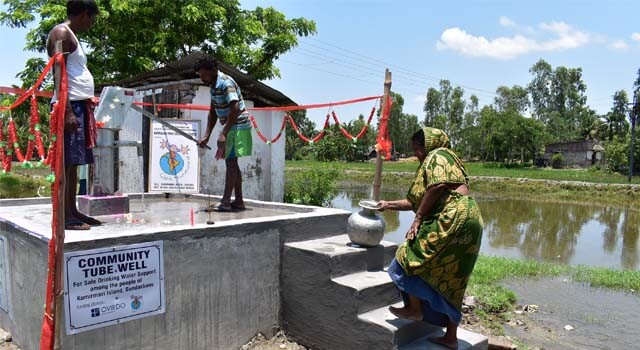
Since the end of May, they have a new well in Karmakar Para (Sunderbans). The well will supply the school students and the community, in total about 2,000 people.
At the inauguration, Global Humanitarian/Marchd project manager Partha Sarathi and a member of the local Panchayet authority reminded families and schoolchildren of the importance of keeping the water source and surroundings clean in order to avoid contaminations and associated pathologies, such as diarrheal diseases that can be very serious in the case of children under 5 years of age.
The World Bank, in its report Building Resilience for the Sustainable Development of Sundarbans (2015) , pointed out the shortage of drinking water supply in the Sundarbans, a mangrove area in the Ganges delta, due to saline intrusion, the limited availability of freshwater aquifers and the submergence of water sources during floods, as well as the irregular supply of adequate disinfectants.
Clean water, sanitation and hygiene are essential to maintain the health and well-being of a population that survives from subsistence agriculture, fishing or honey collection; They improve school attendance and help create communities that resist in an environment and with a climate marked by floods and periodic cyclones that destroy mangrove forests. Having a new source of safe water is a great achievement for those who remain there. (about 43% live below the poverty line)
Additionally, the teachers who participate in our educational program, trained as health promoters since the covid 19 pandemic, and the staff of the Kumirmari Health Center provide awareness sessions on good hygiene and health practices to the families of schoolchildren with whom we work.
Recent Comments